
From the report
The executive support professional exists to give a principal back the one asset they cannot buy more of: attention. Every seat covered in this report, the Executive Assistant, the Chief of Staff, the communications lead, the analyst, and the Office of the CEO that holds them together, is a different mechanism for the same outcome.
The market has moved. Three forces are reshaping this profession at once. The roles have moved up the value chain. The Office of the CEO has become a recognized function. And AI has arrived in the hands of support staff before executives.
At the senior end of this market, an Executive Assistant can clear $500,000 in total compensation, a Chief of Staff package can approach $1 million, and a fully built Office of the CEO can cost more than $6 million a year to run. The people capable of operating at that altitude number in the hundreds, and the seats they hold are seldom advertised.
The principal’s leverage model
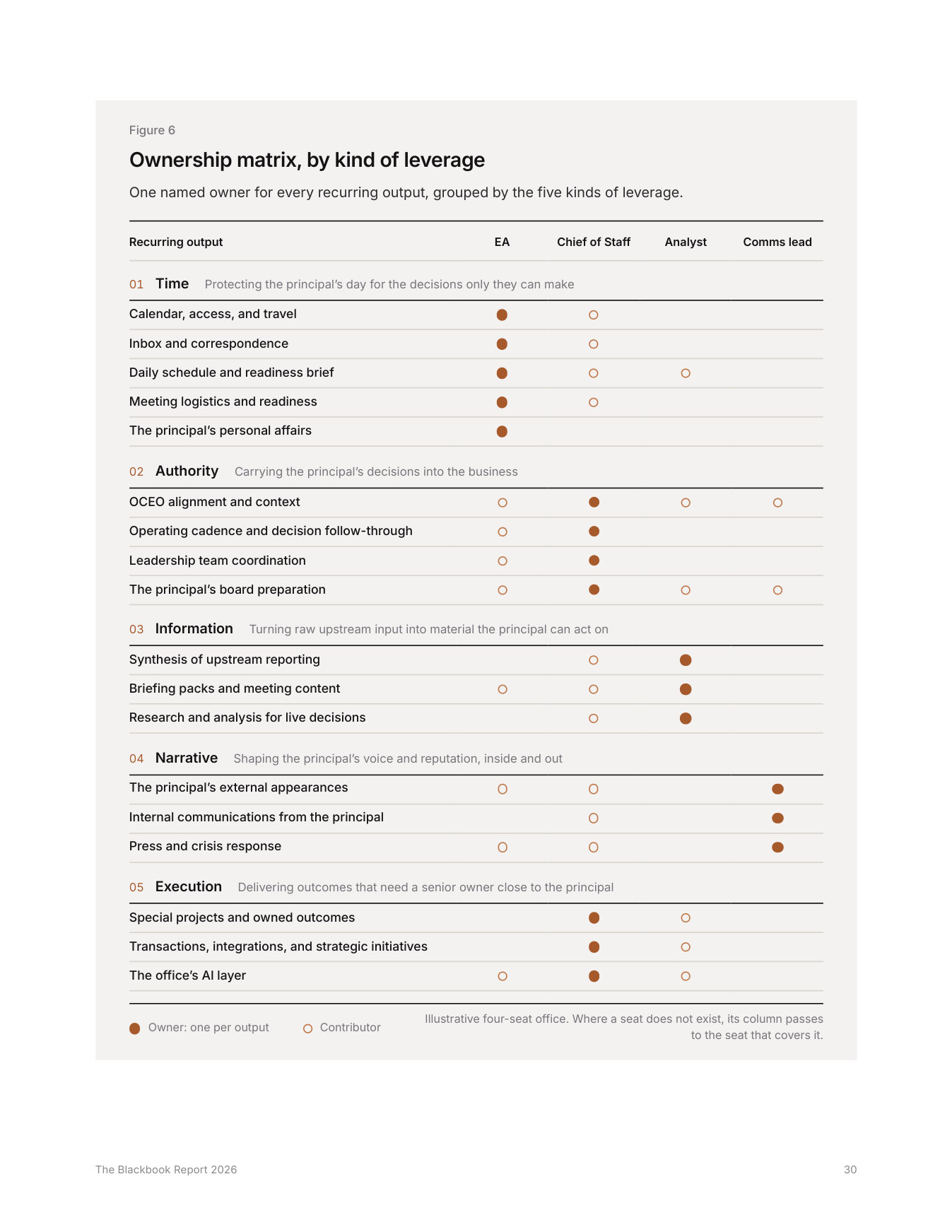
A principal is constrained in five ways, and each constraint is relieved by a different kind of support. Naming them separately is the single most useful thing a principal can do before hiring, because most mis-hires come from wanting one kind of leverage and buying another.
| # | Constraint | Description | Seat |
|---|---|---|---|
| 01 | Time | The principal’s day is consumed by coordination, preparation, and logistics rather than decisions. | Executive Assistant |
| 02 | Authority | Decisions get made but do not get executed; cross-functional work has no owner; the leadership team needs constant chasing. | Chief of Staff |
| 03 | Information | Raw upstream information arrives faster than the principal can digest it; decisions are being made on incomplete or unsynthesized material. | Analyst, or a technical Chief of Staff |
| 04 | Narrative | The principal’s voice and reputation are being shaped by others; press, investor, and internal moments are handled reactively. | Communications lead |
| 05 | Execution | Strategic projects, transactions, and initiatives need senior ownership close to the principal. | Chief of Staff, with analysts on technical work |
Altitude, and how the package is built
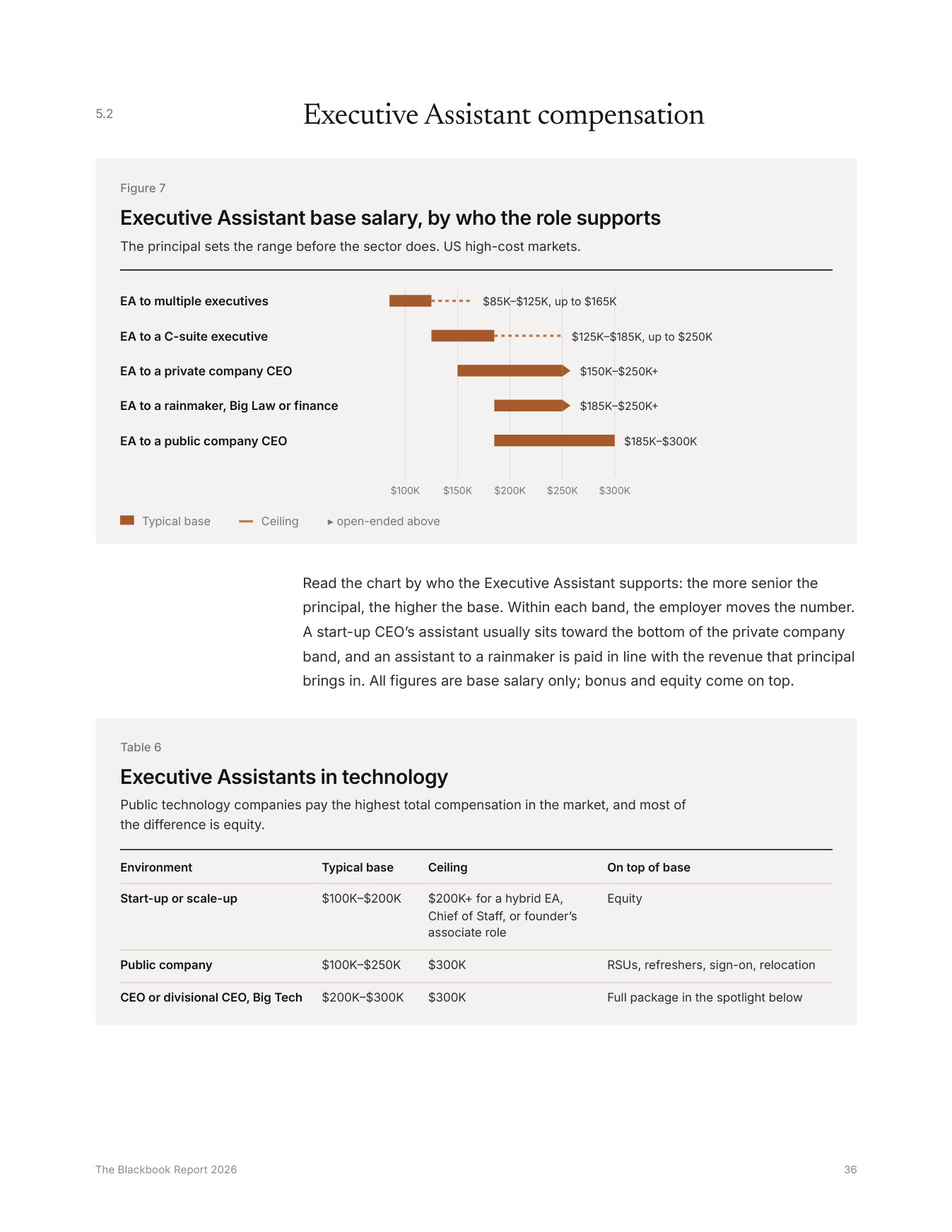
A $150,000 EA and a $500,000 EA might both manage a calendar. The difference is the level of principal they support and the consequence attached to getting it right every single day, without exception.
The number is similar across environments at the senior end; the structure is not. In Big Tech the package is equity-heavy. In finance it is cash-heavy. In the UHNW world it is often almost entirely cash, structured bespoke around the principal and priced to retain.
Take the Big Tech CEO package as one example of how the senior end can clear $500K. Spread evenly over four years, an RSU grant in that range can be worth $100K to $150K a year, and up to $225K at the top of the band. Together with base, bonus, and refreshers, that is one path to the figure above.
| Component | Range | Timing |
|---|---|---|
| Base | $200K–$300K | Annual |
| RSU grant | $400K–$600K, up to $900K | Vests over four years |
| Annual bonus | $50K–$60K | Annual |
| Equity refresher | $100K–$150K | Granted each year |
| Sign-on bonus | $100K–$200K | One time |
Sector by sector, the full report breaks out typical bands, ceilings, and what sits on top of base: bonus, RSUs, carry, and sign-on. These roles are rarely advertised. They are filled quietly, through retained search and trusted referral.
Five configurations of the Office of the CEO
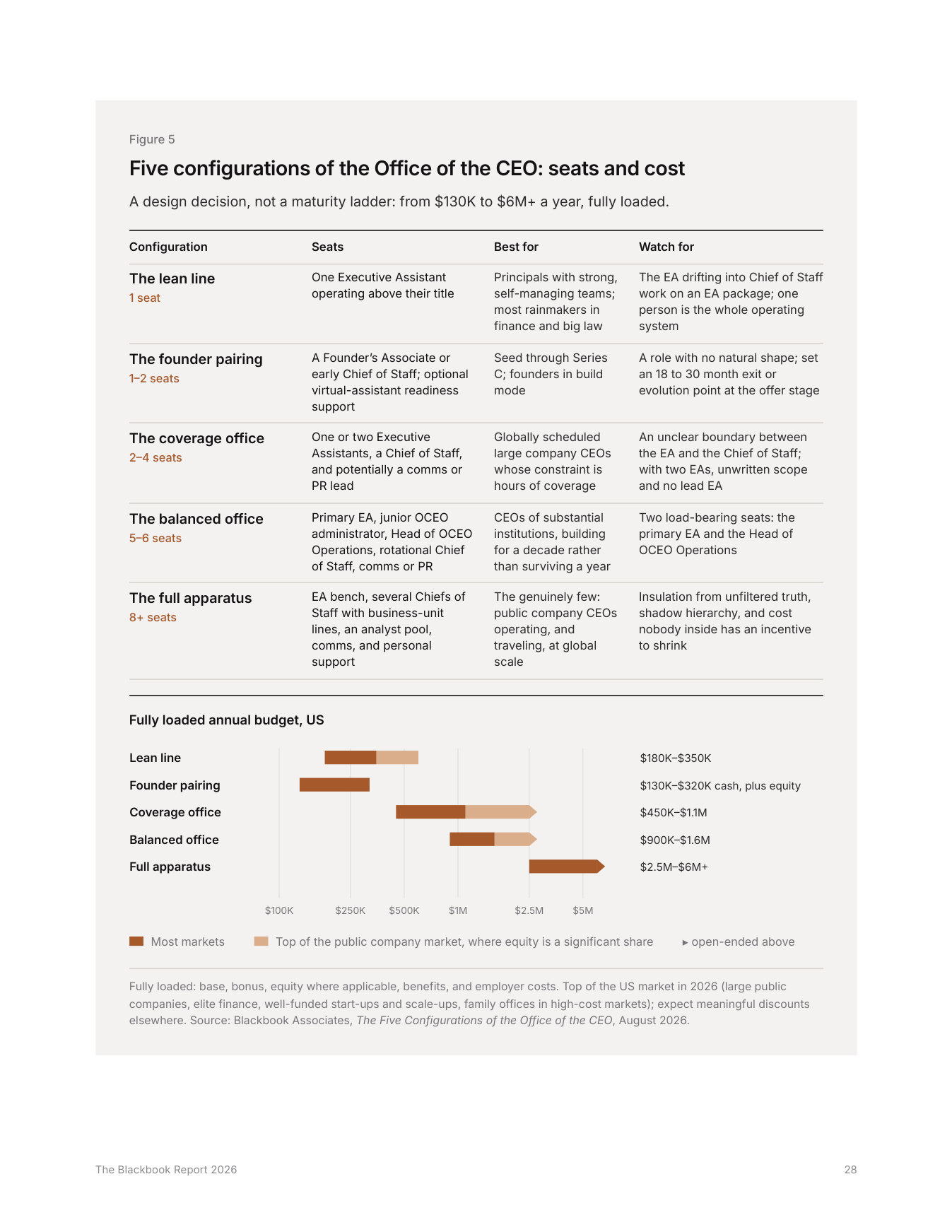
An Office of the CEO exists where one person is no longer enough. Once a principal’s span of control, external exposure, and information load exceed what a single EA or Chief of Staff can absorb, the answer is a team built around the principal with clear roles and one shared purpose.
Five configurations cover most of what we see. The office should always be bespoke. The table below is a useful overview; the build should follow the diagnosis.
| Configuration | Seats | Fully loaded | Best for |
|---|---|---|---|
| The lean line | 1 seat | $180K–$350K | Rainmakers; principals with strong, self-managing teams |
| The founder pairing | 1–2 seats | $130K–$320K + equity | Seed through Series C; founders in build mode |
| The coverage office | 2–4 seats | $450K–$1.1M | Globally scheduled large-company CEOs |
| The balanced office | 5–6 seats | $900K–$1.6M | CEOs of substantial institutions |
| The full apparatus | 8+ seats | $2.5M–$6M+ | Public company CEOs operating at global scale |
Inside the report
Sixty-three pages across eight sections, with figures on compensation by seat and sector, Office of the CEO configurations and ownership, the AI maturity ladder, and the hiring process. A sample of the pages below.
- 01Executive summaryFive things a principal should take from this report3
- 02The principal’s leverage modelFive constraints, and the seat that relieves each6
- 03The four seatsExecutive Assistant, Chief of Staff, communications lead, analyst9
- 04The Office of the CEOConfigurations, cost, ownership, and when to redesign25
- 05The marketCompensation by seat and sector, geography, and scarcity32
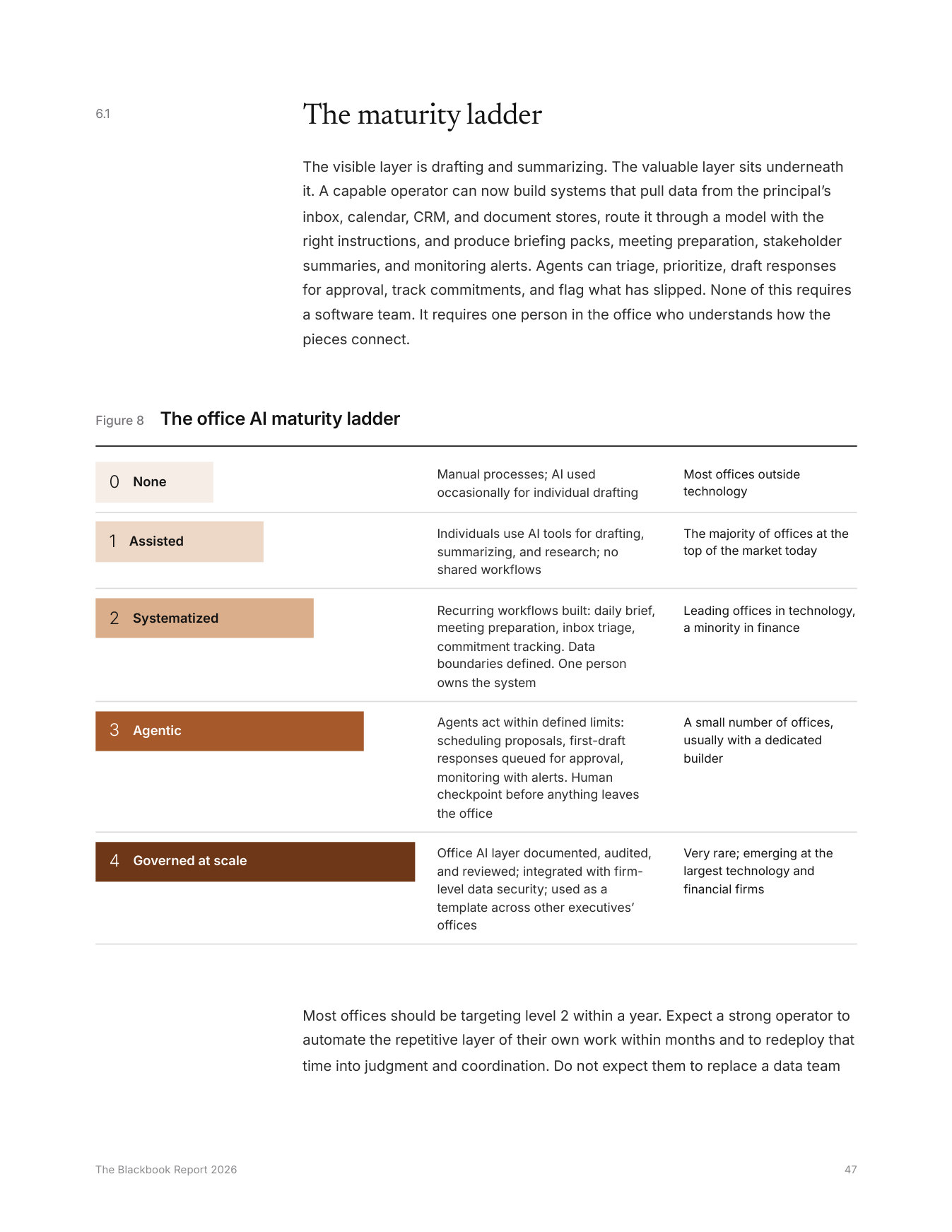
- 06How AI is changing the marketMaturity, workflows, governance, and the AI-native operator46
- 07How to hireScoping, sourcing, assessment, references, and chemistry51
- 08Failure modesThe mistakes that repeat, and how to spot them58
Read the full report
The excerpts above are a sample. The full report covers sector tables, geography and scarcity, the office AI maturity ladder, scenario-based assessment, and how to engage Blackbook.