How to Define a Chief of Staff Role: Personal, Company, or External Orbit?
Most Chief of Staff hires fail because the company never decided which job it was hiring for. Define the orbit first, and the rest of the profile follows.
Why the title keeps producing the wrong hire
Most Chief of Staff searches go wrong before a single candidate is interviewed, because the company has not decided which job it is hiring for. The title covers at least three different roles, and a job description that borrows a little from each will attract candidates who fit none of them well.
The pattern is familiar to anyone who has run or sat in an Office of the CEO, and it usually takes one of two forms. The first is hiring a Chief of Staff with an Executive Assistant background and expecting them to manage the operating cadence and analyze data to support decisions from day one.
The second is hiring a Chief of Staff with a consulting background and an MBA, with no Executive Assistant already in place, and then having them manage the CEO's calendar.
In both cases the company hired a good person for the wrong job, and in both cases that person will usually leave within eighteen months, with the company concluding that the role itself does not work.
There is a simpler way to start. Before you write a job description, decide which orbit of the principal's world the role will live in. That one decision determines the background to hire for, the reporting line, the compensation band, and what the role should grow into.
The rest of this piece sets out the three orbits, how they map to different environments, and what to do once you know which one you need.
Start with the principal, not the org chart
A Chief of Staff exists to extend one person's reach, so the profile has to be defined from that person outward rather than from the org chart inward. The question is where the principal's leverage gap sits, and the orbit model is a way of locating it.
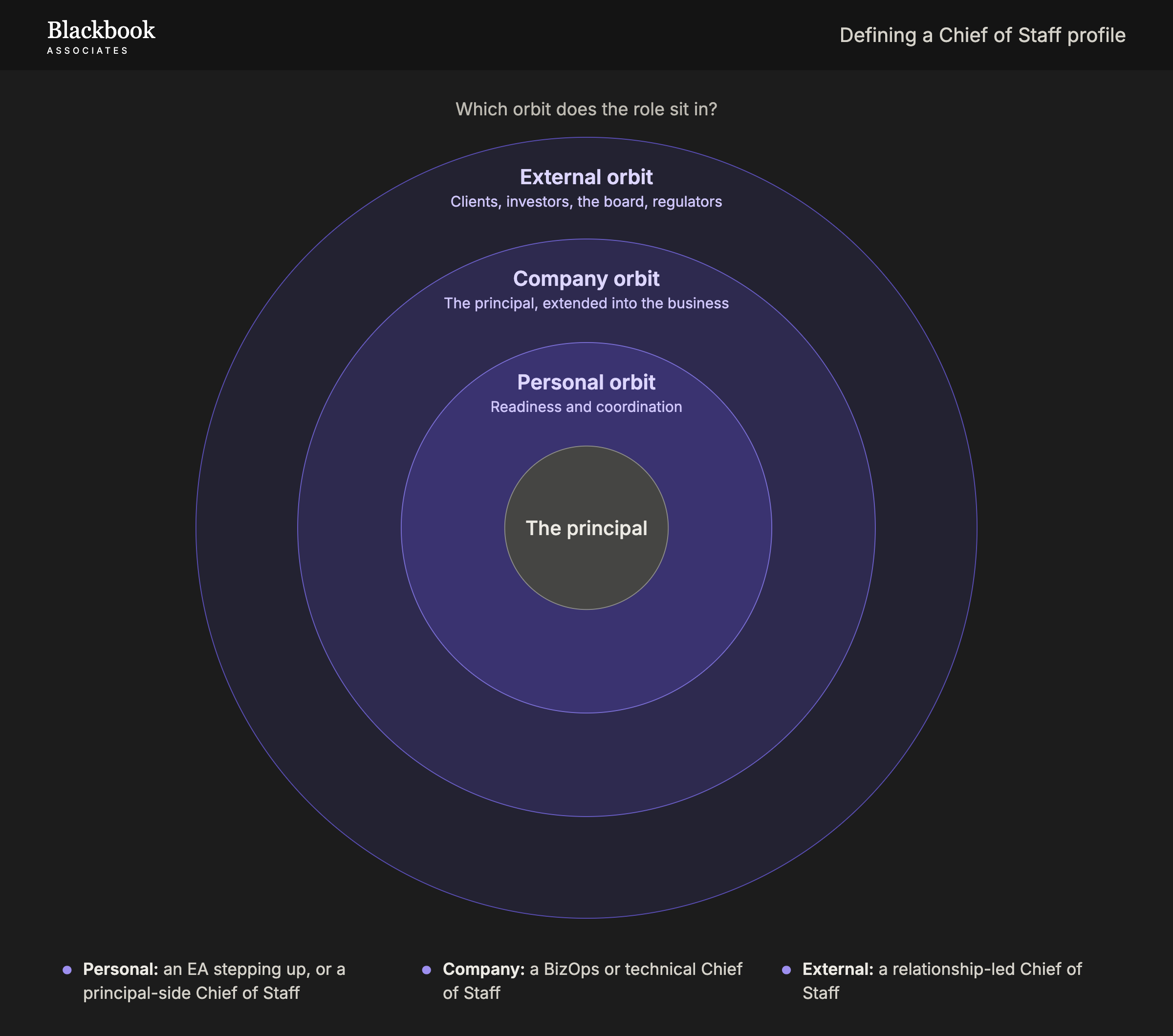
Picture the principal at the center and three concentric orbits around them.
The personal orbit is their immediate world: their time, their information, their decisions, their follow-ups.
The company orbit is the wider business they lead: the planning cycle, the cross-functional problems, the initiatives nobody owns.
The external orbit is everyone outside the walls who matters to them: clients, investors, the board, regulators.
Every Chief of Staff role lives mostly in one of these orbits, and the orbit decides the profile. The same title applied to a role in the personal orbit and a role in the company orbit describes two people with different backgrounds, different instincts, and different definitions of what the role looks like. Treating them as interchangeable is where most of the expensive hiring mistakes in this market come from.
The personal orbit
A role in the personal orbit exists to improve the readiness and coordination of the principal. It covers the who, what, where, and why of their world: who they are meeting and why, what they need to know before they walk in, where the decision stands, and what happened to the thing they asked for three weeks ago.
In practice this means owning the principal's operating rhythm. The Chief of Staff runs the leadership team agenda, makes sure every meeting has a purpose and a pre-read, tracks decisions and chases the follow-ups, and controls what reaches the principal and in what shape. Done well, the principal walks into every room prepared, every decision has an owner, and nothing falls through the gaps.
This is the orbit where many Executive Assistants step up into a Chief of Staff remit, and it is a legitimate Chief of Staff role in its own right rather than a stepping stone to one. The best people in it have usually spent years close to a senior principal and know how a leader's week actually works. Often they still carry some of the Executive Assistant responsibilities at first, with the project work layered on top, and the role becomes more strategic as trust and scope build. The strongest signal in a candidate is judgment under ambiguity: the ability to decide what matters without being told, and to say no on the principal's behalf without creating friction.
The company orbit
A role in the company orbit is an extension of the principal into the wider business. This is the BizOps Chief of Staff: someone who takes the highest-priority, cross-functional problems in the company and drives them to resolution, usually with no formal authority over the people involved.
The work falls into four recurring categories:
- Owning the strategic and operating cadence. The annual plan, the OKR or goal-setting process, the quarterly business reviews, and the leadership meeting rhythm that holds them together. The Chief of Staff makes sure the process has a timeline, the goals are written and tracked, and the reviews arrive on time and in a consistent format.
- Standing up new initiatives. A product launch, a market entry, a pricing change, a new function. The Chief of Staff scopes it, builds the first version of the plan, gets it moving, and then hands it to a permanent owner.
- Building the analytical case for major decisions. The model, the options, the recommendation, and then the tracking of whether the decision delivered what it promised.
- Fixing operational bottlenecks. The cross-functional problems that have no natural owner, where sales blames product, product blames finance, and nothing moves until someone with the CEO's mandate steps in.
The profile is usually an ex-management consultant, ex-investment banker, or MBA, hired for generalist problem-solving rather than functional depth. Alongside the generalist, there is a technical variant of this role: a Chief of Staff with deep expertise in one domain, brought in to lead M&A integration, change and transformation, FP&A, a reorganization, or a cost program. The company orbit is the same; the specialism is what changes.
What this profile does not do, and will usually resent being asked to do, is manage the principal's day. A BizOps Chief of Staff who discovers that half the role is calendar triage will start looking for their next job quite quickly.
The external orbit
The external orbit is the least common of the three as a standalone role, and the easiest to overlook when writing a profile. It covers the people outside the company who matter to the principal: clients, investors, the board, regulators, and the press.
By default, external work folds into one of the other two orbits. A personal-orbit Chief of Staff handles the scheduling, preparation, and follow-up around external relationships. A company-orbit Chief of Staff prepares the board deck and the investor update. In both cases the external work is a slice of the role rather than its center.
It stands on its own when the principal is relationship-heavy and a large share of the revenue flows directly from those relationships. In that situation, the leverage gap sits in keeping dozens of senior relationships warm, informed, and moving, and a Chief of Staff focused mainly on that work is often the smartest hire the principal can make. The profile shifts accordingly: executive presence, commercial judgment, and the ability to represent the principal credibly in a room they are not in, rather than process design or financial modeling.
The distinction to be clear about before hiring is whether the Chief of Staff supports the principal's relationships or conducts some of them independently. The first is a coordination role with a strong external flavor. The second is a representative role, and it needs someone the principal's counterparts will take seriously on their own account.
When one role spans several orbits
Some roles are expected to cross two or all three orbits, and the honest trade-off is dilution of focus. A Chief of Staff who runs the principal's week, owns the planning cycle, and manages investor relations is doing three jobs, and the quality of each will depend on which one is on fire that month.
This is common in start-ups, where resources are tight and the Chief of Staff is expected to wear every hat and get the job done. It can work, and some people are built for it. The ones who thrive tend to be comfortable in chaos, enjoy the pace, and are more motivated by proximity to the founder and the breadth of exposure than by owning a clean remit. They are also harder to find, because the combination of readiness instincts and analytical horsepower in one person is rare (they're also the most likely to go on to be future leaders in their own right).
If you are hiring for a role that spans orbits, two things help.
First, decide which orbit is primary and say so in the profile, so candidates know what the job will look like on a normal week rather than an exceptional one.
Second, plan for the role to split. A hybrid Chief of Staff in a company growing quickly is usually the first hire of what becomes an Office of the CEO, and the second hire should take whichever orbit the first one is weakest in.
How the orbits map to environments
The environment around the principal usually decides which orbit the Chief of Staff lives in, so the setting is a good first guess at the profile before any conversation with the principal.
|
Environment |
Dominant orbit |
Why |
Typical profile |
|---|---|---|---|
|
Large corporation |
Company |
The CEO already has a dedicated Executive Assistant covering the readiness layer, which frees the Chief of Staff for BizOps work across the business. |
Ex-consulting, ex-banking, or MBA generalist; or a technical specialist for M&A, FP&A, or a reorganization |
|
Rainmaker (BigLaw, venture capital, investment banking, real estate) |
Personal and external |
The revenue is attached to the principal's relationships, and someone has to keep those relationships healthy while also keeping the principal ready for them. |
Senior Executive Assistant stepping up, or a relationship-led Chief of Staff with executive presence |
|
Founder-led business or private principal (family office, entrepreneur) |
Personal, with light external |
The principal's own readiness is the bottleneck, and the external crossover is mostly scheduling and follow-up with outside relationships. |
Experienced Executive Assistant or principal-side Chief of Staff with strong judgment and discretion |
|
Start-up or scale-up |
All three |
Resources are tight, so one person covers the principal's week, the operating cadence, and the investor relationship until the company can afford to split them. |
Hybrid operator who thrives in ambiguity; often the first hire of a future Office of the CEO |
These are starting points rather than rules. A large corporation with a new CEO who has no established Executive Assistant may need a personal-orbit hire first, and a founder with a strong operations lead may need a company-orbit Chief of Staff to take the planning cycle off their hands. The table tells you where to begin the conversation with the principal, not where it has to end.
What follows once you know the orbit
Once the orbit is settled, most of the remaining decisions in the profile follow from it, and the job description largely writes itself.
Background. Personal-orbit roles are best filled by people who have spent years close to a senior principal, which usually means Executive Assistants or Chiefs of Staff from smaller/more-agile environments. Company-orbit roles draw on consulting, banking, strategy, and BizOps teams. External-orbit roles need someone who has held a client-facing or investor-facing seat and can speak with authority to the principal's counterparts.
Reporting line and position. A personal-orbit Chief of Staff reports to the principal and sits beside them, often alongside or above the Executive Assistant. A company-orbit Chief of Staff also reports to the principal but spends most of the week with the leadership team and the functions, and may have analysts or a BizOps team underneath.
Compensation. The orbit sets the band. Company-orbit roles are benchmarked against the consulting and finance talent they compete for, and the technical variants against the relevant specialist market. Personal-orbit roles are benchmarked against senior Executive Assistant and Chief of Staff compensation in the principal's sector, which varies more widely than most hiring managers expect. Pricing a personal-orbit role at company-orbit levels, or the reverse, is a reliable way to attract the wrong candidates.
Progression. A company-orbit Chief of Staff is typically a two-to-three-year role that leads into a general management, operating, or functional leadership seat. A personal-orbit Chief of Staff can be a long-tenure role that deepens over time, or it can grow into running the Office of the CEO as the function builds out. Being honest about which path the role offers matters, because the two profiles want different things from it.
What to test for in interviews. For the personal orbit, test judgment and anticipation: give candidates a messy week and ask what they would protect, what they would push back on, and what they would need to know that they have not been told.
For the company orbit, test structured problem-solving and influence without authority: a real cross-functional problem from the business, and how they would get it to resolution.
For the external orbit, test presence, market knowledge, and discretion: how they would handle a difficult investor or a client who is going around the principal.
The most expensive mistake
The costliest error a company can make in this market is to hire one orbit and expect another, then conclude that the person is underperforming.
The usual version is hiring an Executive Assistant or principal-side Chief of Staff and expecting them to step into BizOps work on day one: run the planning cycle, build the business case, take the reorganization.
The reverse happens too, when a company hires a former consultant and is surprised that the principal's calendar, pre-reads, and follow-ups are no better than before.
In both cases the hire was sound and the specification was wrong. The person was recruited against a job description that described one orbit and then measured against expectations drawn from another. They will usually work hard to close the gap, and some will manage it, but most will leave within a year or two, and the company will have spent a search fee, a year of salary, and a good deal of the principal's attention learning something it could have decided in an afternoon.
The fix is to make the orbit decision explicit before the search starts, write it into the job description, and hold the interview process to it. If the role genuinely needs two orbits, say which is primary and hire for that one, then build the other through the next hire rather than through the first person's weekends.
A short diagnostic before you write the job description
Five questions, answered honestly with the principal, will usually settle the orbit.
- Where does the principal's week break down most often: in their own preparation and follow-through, in cross-functional work nobody owns, or in external relationships that are not getting the attention they need?
- Who covers the readiness layer today? If a strong Executive Assistant already does, the Chief of Staff is probably a company-orbit hire. If nobody does, it is probably a personal-orbit hire, whatever the title says.
- How much of the company's revenue or strategic value flows directly through the principal's relationships? Above a certain share, the external orbit stops being a slice of the role and becomes the role.
- What will the Chief of Staff be doing on an ordinary Tuesday in month four? If the answer is mostly meetings with the leadership team and functions, it is a company-orbit role. If it is mostly time with the principal and their immediate world, it is a personal-orbit role.
- What should the role have grown into in three years? The answer tells you which profile will stay and which will leave.
There are nuances the orbit model does not capture, and every principal is different. But as a starting point for a search, deciding the orbit first is the single most useful thing a company can do, and it is the first question we ask on every Office of the CEO mandate.
Blackbook Associates is a retained search firm that builds the teams behind exceptional leaders: Chiefs of Staff, senior Executive Assistants, and Office of the CEO functions for public companies, private firms, and scale-ups. If you are defining a Chief of Staff role and want a second opinion on the profile before you go to market, we are happy to talk it through.