Why an Office of the CEO matters
Most people think an Office of the CEO exists to make the CEO’s life easier. The bigger payoff is in how the rest of the company runs: decisions get made faster, land with an owner, and get followed through, and the CEO spends their time on the calls only they can make.
The common view, and what it misses
A common view of the Office of the CEO is that it exists solely to make the CEO's life easier. That is true in a sense, and it is the smallest part of the picture.
A well-built office is a function of efficiency and leadership for the entire organization. The CEO having a calmer life is a byproduct of that, not the purpose. In The Blackbook Report 2026 we put it this way: the support professional exists to give a principal back the one asset they cannot buy more of, which is attention, and a support hire is an investment in the principal's focus. If that focus produces better and faster decisions, the hire has paid for itself many times over. The distinction matters because it changes who the office is for, how it is measured, and whether a CFO or a founder sees it as a layer of cost or as infrastructure.
The easiest way to see the distinction is to look at what happens to a piece of information when there is no office, and what happens to the same piece of information when there is one.
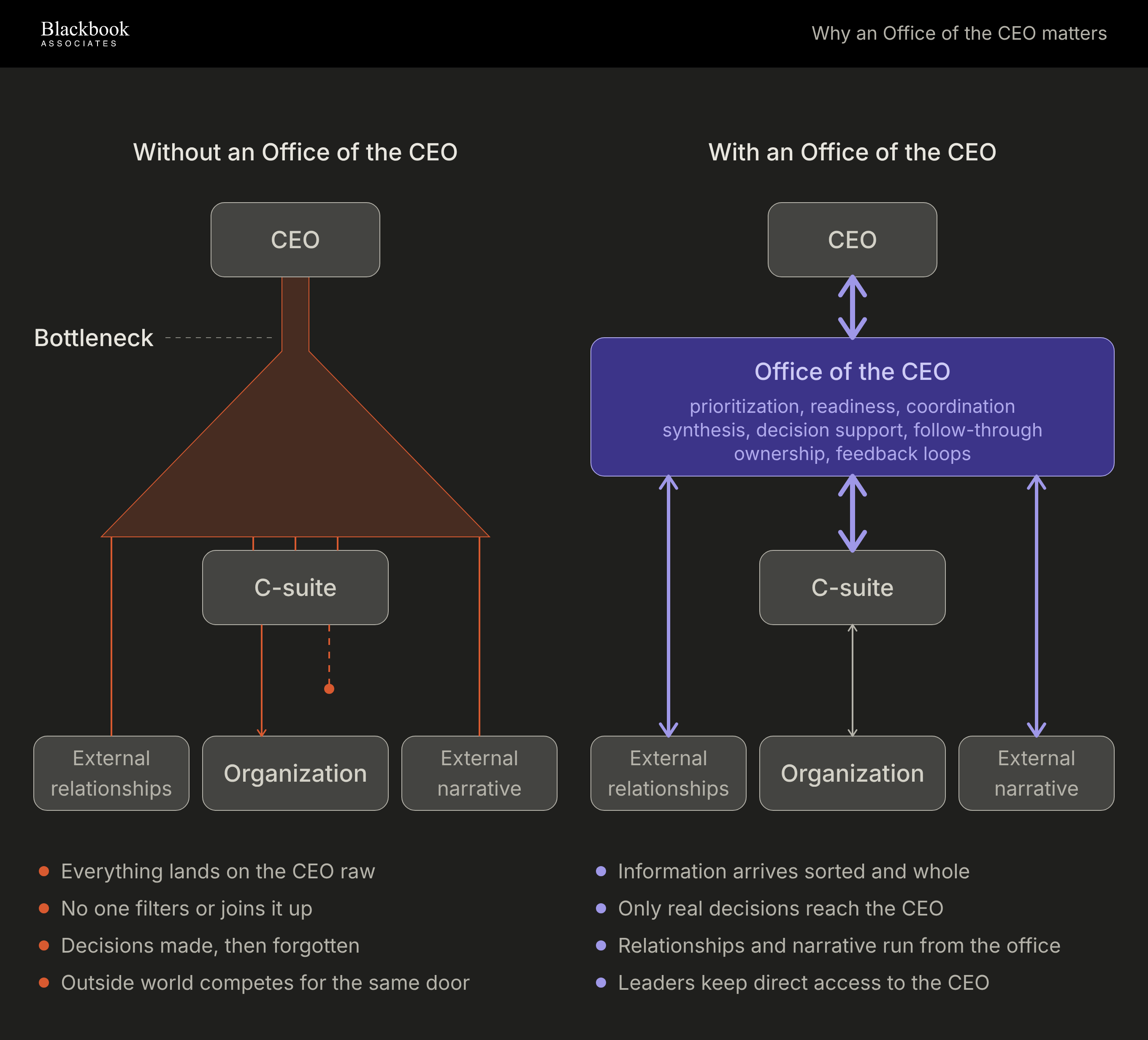
Without an office: the CEO is the only place things join up
On the left of the visual, information arrives from every direction, unstructured and unsorted. The CFO brings a budget question, the CHRO a retention problem, the COO a supplier issue, and none of them knows what the other two have raised that week. The board wants a pre-read, an investor wants a call, a journalist wants a comment, and all of it lands in the same inbox.
The CEO has to prioritize it, synthesize it, coordinate the response, decide, and push the decision back down the organization. They also have to remember what was said and done, and carry the external relationships and the external narrative at the same time. The CEO is the only point in the company where these threads meet, so the CEO becomes the bottleneck, and the funnel in the diagram is not an exaggeration.
Two things follow from that. Decisions wait, because the queue for the CEO's attention is the longest queue in the building. And decisions fade, because once made they depend on the CEO's own memory to be followed up. The dotted line that stops short of the organization on the left is the initiative that was agreed in a meeting and never heard of again.
With an office: the heavy lifting moves
On the right, the office takes on that heavy lifting. Information still arrives from every direction, but it arrives at a function built to receive it. The Blackbook Report 2026 describes an Office of the CEO as a machine: it takes in everything directed at the principal, processes it, and returns decisions, outputs and readiness. The office prioritizes, prepares, coordinates and synthesizes, so what reaches the CEO is sorted and whole, with the options framed, the data checked and the owner named. The CEO is freed to focus on the handful of decisions only they can make.
The C-suite keeps its direct access. This is the point most often misunderstood by executives who hear "Office of the CEO" and picture a gatekeeper, and the Blackbook Report lists that outcome as a failure mode in its own right: the Chief of Staff as bottleneck, where everything routes through one person, the leadership team treats them as the principal's spy, and the principal uses them to avoid conversations they should be having directly. A well-built office does the opposite. The CFO still walks into the CEO's room for anything that matters. What changes is that there is now a function behind the leadership team that puts their plans into motion, tracks them, and makes sure every plan has an accountable owner. The office takes the volume, not the relationship.
The external channels move too. Relationships with the board, investors, partners and press are prepared, scheduled and followed up by the office, and the external narrative is owned or co-owned there alongside communications. The CEO remains the face of those relationships, but the work that surrounds each conversation no longer competes with the CFO for the same door.
The bottleneck must not simply move one level down
There is a nuance here that experienced Chiefs of Staff raise before anyone else does. If every initiative and every cross-functional decision has to pass through the office for approval, the bottleneck has not been solved. It has been relocated from one executive to a small team, and the leadership team now waits on the office instead of the CEO. Our Blackbook Report 2026 lists this as a failure mode in its own right, and in the largest offices it names the related risks of a shadow hierarchy and a principal insulated from unfiltered truth.
The measure of a good office is therefore the opposite of how much traffic it controls. It is how many issues the leadership team resolves directly, with clear ownership and without an unnecessary escalation, because the office has removed the friction that used to push those issues upward. A well-run office raises the quality of decisions made below the CEO and lowers their number above it. When the escalation count falls and the C-suite stops asking who they need to go through, the office is working. When department heads feel that in-flight projects are stalling behind it, morale drops at the top of the company as well as below, and the office has become the thing it was built to prevent.
Two disciplines keep it on the right side of that line. The first is transparency. The office should never be a black box where only the Chief of Staff knows how information flows, why a decision was made, or where responsibility sits. Decisions, owners and status should be documented and visible, so that if someone in the office left tomorrow, their successor could step in without rebuilding the operating model. The second is the CEO's own access to the mood of the organization. One reason CEOs hesitate to build an office is the fear that a layer will cut them off from their team. A good office protects against that by design, bringing the unfiltered view in rather than smoothing it out, and by leaving the direct lines in place. The test of a Chief of Staff is not how indispensable they become but how much more capable the organization is because of them.
A standing home for work that belongs to no one function
Every company has work that does not fit neatly inside a single function: a short-term initiative that touches three departments, an external audit, a change or transformation program, an integration after an acquisition. Without an office, this work is usually handed to whichever executive looks least busy, or to the CEO, and it competes with that person's day job until it quietly stalls.
An Office of the CEO gives that work a standing home. In the Blackbook Report's terms this is execution leverage: outcomes that need a senior owner close to the principal. Each piece runs with its own owner, often inside a function, but with a dotted line back into the office and in turn to the CEO. The office holds the timeline, surfaces the blockers, and keeps the thread visible when the people doing the work are pulled back to their core roles. It is the same discipline the Blackbook Report recommends inside the office itself, a written ownership matrix with one named owner for every recurring output, applied to the work that would otherwise have none.
The return on a few salaries
An Office of the CEO is a line item that does not sell or build anything, which makes it an easy one for a finance team to question. The cost is visible and the return is spread across the company, so it helps to name where the return lands.
The most expensive hours in the company stop being spent on triage. Decisions reach the organization sooner and arrive with an owner, so less work is redone or dropped. The board, investors and the market get a CEO who shows up prepared and a narrative that stays consistent. Internally, the leadership team spends less time reconstructing what was agreed and more time executing it.
There is a speed dividend as well. The Blackbook Report calls this the information constraint: once a principal sits above a certain volume of reporting, the bottleneck moves from time to comprehension. In most companies, data, insights and the actions they call for reach the CEO late, because reporting runs on a monthly cycle, because nobody owns the number, or because the person who has it is waiting for the right meeting. An office closes that gap. It knows which numbers the CEO is watching, who holds them, and when they change, so insight arrives close to real time and already attached to a recommendation. Faster and more reliable information means better decisions, and fewer decisions made on last month's picture.
Against the budget of a few people, a well-run office returns sharper CEO focus, stronger external and internal outcomes, and better leadership across the entire organization. Price the cost of one slow decision, one lost initiative or one mixed message at that level, and the return on investment becomes hard to argue with.
How large the office needs to be
An Office of the CEO does not have to be large. The Blackbook Report 2026 sets out five configurations, from a single Executive Assistant operating above their title, which it calls the lean line, through the founder pairing and the coverage office, to the full apparatus of a global public company CEO with an EA bench, several Chiefs of Staff, an analyst pool and communications. Fully loaded, that range runs from roughly $180,000 a year to more than $6 million, and the right point on it is a design decision rather than a maturity ladder.
A founder of a scale-up or the leader of a smaller firm can get most of the benefit from one or two people. The Blackbook Report's sequencing is to hire the senior Executive Assistant first, because time is the constraint everything else depends on, and the Chief of Staff second, once the principal can name three outcomes for them to own. That pairing covers prioritization, preparation, follow-through and the external calendar, and gives cross-functional work its first real home. One rule from the Blackbook Report applies at every size: once more than one person supports you, you have an office, whether you have designed it or not, so the ownership and the operating cadence should be written down from the start.
Where the return actually shows up
The CEO's life does get easier. That is real, and it is worth having. But the measure of an Office of the CEO is what happens two levels down, where decisions arrive with context, land with an owner, and get followed through. Build the office for the CEO alone and you get a better-run calendar. Build it for the organization and you get a company that moves at the speed its leader can think.
Building this function is most of what we do at Blackbook Associates, from the Chief of Staff who runs the office to the people around them. The Blackbook Report 2026 covers the full picture: the five kinds of leverage, the four seats, the configurations and what they cost, and the failure modes that repeat. If you are setting one up, or fixing one that is not working, we would be glad to talk.